Kidney Healthy Aging & mineral metabolism
Isabel Rubio-Aliaga (see short CV (PDF, 105 KB) , ORCID)
Subjects wanted for clinical study
For a scientific study we are looking for healthy women and men aged between 18 and 25 years or 63 and 70 years old, with a BMI between 18.5 and 26 kg/m2, with normal blood pressure and kidney function.
Topics: Our running projects :
Aging and the control of mineral metabolism. Having investigated how high phosphate intake influences ageing, we are currently examining how ageing influences phosphate metabolism. In mice, we found that the response to a phosphate challenge depends on age. Aged mice showed a more pronounced and sustained response to an oral phosphate load, which could have negative effects on healthy ageing. In everyday life, we are regularly exposed to acute phosphate loading through our diet. Therefore, we aim to establish whether age and sex influence the body’s response, with the ultimate goal of promoting healthy ageing. We are therefore looking for healthy subjects willing to participate in this clinical study. The flowchart is displayed below. Flyer (PDF, 182 KB)

If you are interested in participating in this study and meet the above criteria, please contact
PD Isabel Rubio Aliagaisabel.rubioaliaga@uzh.ch,

Background: Serum phosphate and calcium levels are tightly regulated by various hormones, namely parathyroid hormone (PTH), 1,25(OH)2-dihydroxyvitamin D and fibroblast growth factor 23 (FGF23). Various diseases (mainly genetic) and nutritional patterns affect mineral homeostasis, and are associated with cardiovascular and renal diseases.
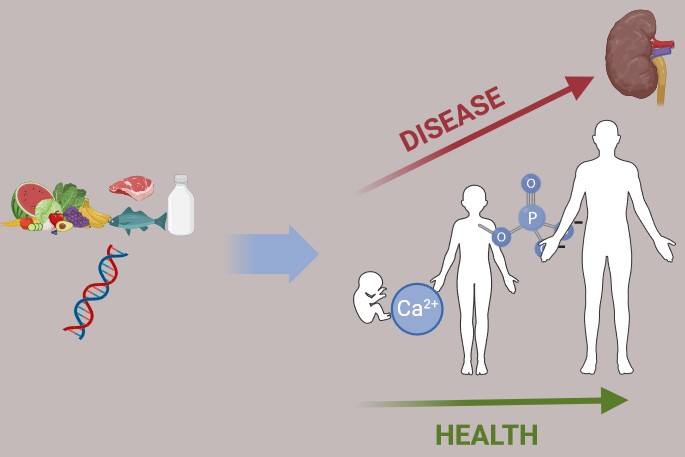
We are interested in how nutritional habits and mutations in selected genes impact on mineral metabolism and the impact on healthy aging. Moreover, we aim to understand if aging affects mineral metabolism.
Past projects included the use of mouse models to investigate the risk of high FGF23 levels on cardiovascular disease, the relation between mineral homeostasis and the Jak/Stat pathway and the impact of a chronic high phosphate diet on aging. We learned that solely high FGF23 does not induce left ventricular hypertrophy and that constitutive activation of Jak1 leads to massive production of FGF23 in the liver, causes growth impairment and skeletal alterations. Furthermore, we investigated the impact of a continuously high phosphate diet from adulthood to elderhood on renal function and macronutrient utilization in mice. Our studies show that a chronic phosphate intake in mice does not cause major renal alterations, but is detrimental for bone health and causes changes in body composition and macronutrient utilization.
Topics: Our running projects comprise:
- Phosphate and Kidney Stone Disease. Human studies: Using human data and biobank samples from the Swiss Kidney Stone Cohort (SKSS) we want to investigate the influence of phosphate on the risk of developing kidney stones. We further search for appropriate surrogates to better assess phosphate intake and to investigate the relationship between phosphate and renal function. Animal studies: we are investigating how mutations in selected genes lead to the development of calcium phosphate stones.
- Aging and the control of mineral metabolism. After investigating how high phosphate intake influences aging, we are looking now at how aging is influencing phosphate metabolism. We also study if the systemic plasticity in response to a phosphate challenge is different when aging.
- Impact of ablation of mitoribosomal protein function on kidney healthy aging. We are investigating a mouse model for a ram mutation that increase the physiological error rate of translation in a random and stochastic manner (Rps9 D95N), and has been shown to cause premature aging. Our ongoing studies show that these mutation also cause premature renal aging.
Collaborations: Our current collaborators are the German Mouse Clinic at the Helmholtz Zentrum in Munich (Germany), the Department of Medicine at the University of Oviedo (Spain), the Institut for Medical Microbiology at the University of Zurich, the SKSS from the Swiss National Centre of Competence in Research (NCCR) Kidney Control of Homeostasis (Kidney.CH), and the Nutrition, Biomarkers & Health Research Group at the University College Dublin (Ireland).